


 PLATFORM UPDATE:

Robust hybrid hydrogels with good rectification properties and their application as active materials for dye-sensitized solar cells: insights from AC impedance spectroscopy†
Abstract
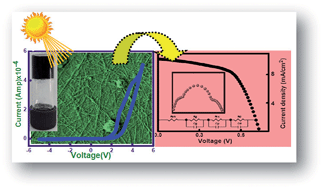
Dihybrid (GP) and trihybrid (GPPS) hydrogels constructed by 5,5′-(1,3,5,7-tetraoxopyrrolo[3,4-f]isoindole-2,6-diyl)diisophthalic acid (P), graphene oxide (GO) and P, GO, and PEDOT:PSS are studied. The gelation occurs through H-bonding and π–π stacking interactions. A magnificent improvement occurs in the mechanical properties of the hybrid gels compared to the P gel. The dc-conductivity of GPPS xerogels is 4–5 orders of magnitude higher compared to the GP and P xerogels. The current–voltage (I–V) characteristic curves of the GP and GPPS gels exhibit rectification properties with the highest rectification ratio of 61; however, the xerogels exhibit semiconducting nature. The GP and GPPS xerogels exhibit photoresponse behavior, and the on–off cycles display a stable photocurrent for the latter system. Dye-sensitized solar cells (DSSCs) are fabricated taking the GPPS gels as active materials and the power conversion efficiency (PCE) increases with the increase of PEDOT:PSS concentration showing a maximum PCE of 4.5%. The IPCE curve shows an absorption range of 360–700 nm with the maximum absorbance of ∼57%. Impedance spectroscopy indicates a considerable difference in the Nyquist plots between the xerogels and gels; the latter exhibit a semicircle with an additional spike corresponding to the Warburg impedance. The Cole–Cole plot of the DSSC consists of three semicircles and the equivalent resistance–capacitance circuits elucidate the PCE values.
 Please wait while we load your content...


