


 PLATFORM UPDATE:


Dynamic self-assembly of microscale rotors and swimmers†

Abstract
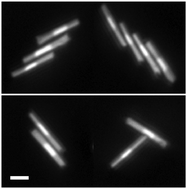
Biological systems often involve the self-assembly of basic components into complex and functioning structures. Artificial systems that mimic such processes can provide a well-controlled setting to explore the principles involved and also synthesize useful micromachines. Our experiments show that immotile, but active, components self-assemble into two types of structure that exhibit the fundamental forms of motility: translation and rotation. Specifically, micron-scale metallic rods are designed to induce extensile surface flows in the presence of a chemical fuel; these rods interact with each other and pair up to form either a swimmer or a rotor. Such pairs can transition reversibly between these two configurations, leading to kinetics reminiscent of bacterial run-and-tumble motion.
 Please wait while we load your content...


