


 PLATFORM UPDATE:

Fast enhancement on bondability of wheat straw surface for bio-composites manufacture via dielectric barrier discharge plasma
Abstract
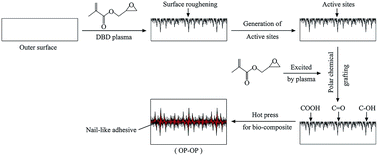
Waxy layer in outer surface of wheat straw (WS) has greatly limited its application in bio-composites manufacture owing to the poor bondability. Dielectric barrier discharge (DBD) plasma using glycidyl methacrylate (GMA) was applied in outer surface of WS in order to enhance the bondability for bio-composites manufacture. The chemical properties, morphology, and wettability of WS surface after GMA plasma treatment were investigated by attenuated total reflection infrared spectroscopy (ATR-IR), X-ray photoelectron spectroscopy (XPS), Boehm titration, atomic force microscopy (AFM), scanning electron microscopy (SEM), and optical contact angle measurement (OCA). Moreover, the two most commonly used adhesives, namely urea-formaldehyde resin (UF) and phenol formaldehyde resin (PF), were applied to evaluate the surface bondability of WS-based composites. The obtained results showed that numerous polar functional groups (C–OH, C![[double bond, length as m-dash]](https://www.rsc.org/images/entities/char_e001.gif) O, and COOH) were incorporated into WS surface. Surface oxidation and etching effects by GMA plasma treatment result in the appearance of numerous spots and the increase in surface roughness. Moreover, the dramatic increase in surface free energy and attenuation coefficients (K) were observed, indicating the improved wettability. The increased roughness, improved wettability, and enhanced polarity favor the dispersion and permeation process of adhesives and the formation of nail-like adhesives. These facts synergistically improve the bondability of wheat straw surface, demonstrating the increased shearing strength from 0.068 MPa to 1.423 MPa when using PF as adhesive.
O, and COOH) were incorporated into WS surface. Surface oxidation and etching effects by GMA plasma treatment result in the appearance of numerous spots and the increase in surface roughness. Moreover, the dramatic increase in surface free energy and attenuation coefficients (K) were observed, indicating the improved wettability. The increased roughness, improved wettability, and enhanced polarity favor the dispersion and permeation process of adhesives and the formation of nail-like adhesives. These facts synergistically improve the bondability of wheat straw surface, demonstrating the increased shearing strength from 0.068 MPa to 1.423 MPa when using PF as adhesive.
 Please wait while we load your content...


