


 PLATFORM UPDATE:

Partial oxidation of 2-methyl-1,3-propanediol to methacrylic acid: experimental and neural network modeling

Abstract
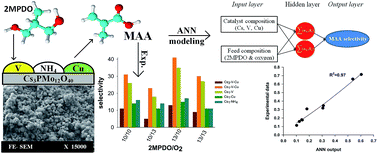
Methacrylic acid (MAA) is a specialty intermediate to produce methyl methacrylate (MMA), which is a monomer for poly methyl methacrylate. Current processes to MMA and MAA rely on expensive feedstocks and multi-step processes. Here we investigate the gas-phase oxidation of 2-methyl-1,3-propanediol (2MPDO) to MAA over heteropolycompounds as effective catalysts, finding that the maximum selectivity to MAA was 41% with 63% conversion of reactant at 250 °C over Cs(NH4)2PMo12O40(VO)Cu0.5. Cesium (Cs) stabilized the catalyst structure at 250 °C, and vanadium(V) and copper (Cu) played a positive role as an oxidant and promoter, respectively. A 0.3 mm nozzle atomized the liquid reactant over the catalyst surface into a μ-fluidized bed reactor. The proposed Artificial Neural Network (ANN) model predicts MAA selectivity based on 2MPDO and oxygen compositions and catalyst components (Cs, V, Cu) as independent factors. The model accounts for 97% of the variance in the data (R2 = 0.97). Vanadium as a catalyst component and oxygen concentration are the two most significant factors. Genetic algorithms (GA) coupled with ANN modeling optimized the input parameters to improve the selectivity. The selectivity to MAA over the optimized catalyst (Cs(NH4)2PMo12O40(VO)Cu0.15) and optimum feed compositions (2MPDO/O2/Ar = 13%/10%/77%) was 43% at 250 °C.
 Please wait while we load your content...


