


 PLATFORM UPDATE:


Highly sensitive potentiometric sensors for thorium ions detection using morpholine derivative self-assembled on silver nanoparticles
Abstract
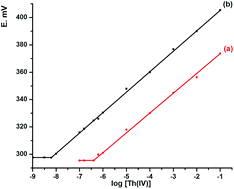
In this work, 1-dodecyl-4-(((3-morpholinopropyl)imino)methyl)pyridin-1-ium bromide (DMP-Br) [L1] was synthesized and self-assembled on silver nanoparticles (DMP-Br-SNPs) [L2]. The prepared compounds were used in the fabrication of screen-printed electrodes to quantitatively sense Th(IV) in real samples conditions. The optimized electrodes based on L1 and L2 exhibited Nernstian slopes of 14.30 ± 0.71 and 15.11 ± 0.47 mV per decade over Th(IV) concentration ranges of 4.0 × 10⁻⁷ to 1.0 × 10⁻¹ and 6.3 × 10⁻⁹ to 1.0 × 10⁻¹ mol L−1 with detection limits of 4.0 × 10⁻⁷ and 6.3 × 10⁻⁹ mol L−1; respectively. In addition, these electrodes showed independent response in the pH ranges 2.5–9.0 and 2.0–9.5, and fast response times of 11 and 5 seconds. Based on durability study results, the optimized electrodes containing L1 and L2 can be used for more than 6 and 7 months, respectively, without any divergence in the electrode potential. Selectivity studies showed that incorporation of SNPs led to enhanced selectivity toward Th(IV) over a wide variety of other metal ions. The effect of solution temperature on the electrode performance was investigated in the range 10–50 °C and the electrodes' isothermal temperature coefficients (dE°/dT) were calculated. The developed electrodes have been successfully applied for Th(IV) ion potentiometric determination in water samples with sensitivity comparable to the reference method and the ability of field measurement.
 Please wait while we load your content...


