


A series of BiOxIy/GO photocatalysts: synthesis, characterization, activity, and mechanism†
Abstract
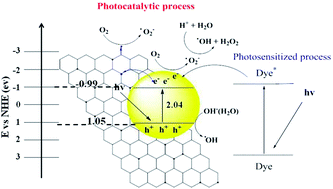
A series of bismuth oxyiodide (BiOxIy)-grafted graphene oxide (GO) sheets with different GO contents were synthesized through a simple hydrothermal method. This is the first report where four composites of BiOI/GO, Bi4O5I2/GO, Bi7O9I3/GO, and Bi5O7I/GO have been characterized using X-ray diffraction, transmission electron microscopy, scanning electron microscopy energy-dispersive spectroscopy, Fourier transform infrared spectroscopy, X-ray photoelectron spectroscopy, and diffuse reflectance spectroscopy. The assembled BiOxIy/GO composites exhibited excellent photocatalytic activities in the degradation of crystal violet (CV) under visible light irradiation. The order of rate constants was as follows: Bi7O9I3/GO > Bi4O5I2/GO > Bi4O5I2 > Bi7O9I3 > Bi5O7I/GO > BiOI/GO > BiOI > Bi5O7I > GO. The photocatalytic activity of the Bi7O9I3/GO (or Bi4O5I2/GO) composite reached a maximum rate constant of 0.351 (or 0.322) h−1, which was 1.8 (or 1.7) times higher than that of Bi7O9I3 (or Bi4O5I2), 6–7 times higher than that of BiOI/GO, and 119–130 times higher than that of BiOI. The quenching effects of different scavengers and electron paramagnetic resonance demonstrated that the superoxide radical (O2˙−) played a major role and holes (h+) and hydroxyl radicals (˙OH) played a minor role as active species in the degradation of crystal violet (CV) and salicylic acid (SA). Possible photodegradation mechanisms are proposed and discussed in this research.
 Please wait while we load your content...


