


 PLATFORM UPDATE:

Adsorptive removal of Ni(ii) ions from aqueous solution and the synthesis of a Ni-doped ceramic: an efficient enzyme carrier exhibiting enhanced activity of immobilized lipase†
Abstract
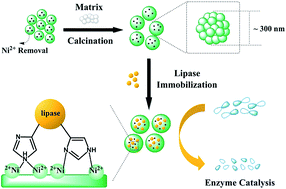
We herein report a novel strategy for the removal of heavy metals and the subsequent preparation of a metal ceramic for immobilizing enzymes. To demonstrate this concept, Ni2+ ions were removed from an aqueous solution via entrapment by chitosan nanoparticles, and the resulting Ni(II)-containing precipitate was mixed with the ceramic matrix to give the Ni-doped ceramic (Ni-CP), which was subsequently applied in lipase immobilization. Under optimized conditions, Ni2+ removal reached 99.4%, and the Ni-CP showed significant chelation towards lipase following immobilization. In addition, a lipase activity yield of 164% was obtained under optimal conditions. Furthermore, the thermal and storage stabilities of Ni-CP-lipase exhibited a wider applied range, and the Ni-CP reusability was maintained at 97.5% following 20 cycles, suggesting high stability and excellent recyclability. Hence, the entrapped Ni2+ exhibited improved stability, thus reducing leakage into the environment. Furthermore, the chelation between Ni2+ and lipase improved enzyme activity and stability, and thus, may be suitable for application in large-scale production. It is therefore expected that this novel approach for enzyme immobilization has the potential to serve as an important technique in the field of biocatalysis.
 Please wait while we load your content...


