


 PLATFORM UPDATE:

Stereo-chemical contributions to the glass transition and liquid–liquid phase separation in high molecular weight poly(N-vinyl carbazole)
Abstract
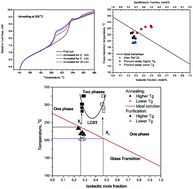
The effects of thermal history and purification on poly(N-vinyl carbazole) (PVK) was investigated focusing on thermal, dielectric and structural analyses. A single glass transition temperature, Tg at 225 °C was observed in the case of the material as received, while two distinct Tgs were identified in the purified samples. Thermal annealing at a temperature above 275 °C also introduced a transition identical to that observed on purification. The nature of the two transitions was confirmed to be that of α-transitions having activation enthalpies of 400 ± 50 kJ mol−1 as determined by dielectric relaxation spectroscopy. No change in molecular weight was observed and 1H-NMR spectroscopy showed that there was little or no change in tacticity as a result of these treatments. It is suggested that liquid–liquid phase separation occurs by separation of isotactic rich segments from a matrix which is predominantly atactic, as indicated by the Tg temperature. It is considered that the liquid–liquid phase separation was driven by the differences in solubility of two stereo-isomers. This mechanism is preferred to that of phase separation by molecular weight driven by the higher molecular weight phase forming a liquid crystalline structure since the observed Tgs at 196, 215 and 225 °C have differences too great to be accounted for by changes in molecular weight alone but consistent with the known Tg values of the stereoregular polymers.
 Please wait while we load your content...


