


 PLATFORM UPDATE:


Phthalazinone structure-based covalent triazine frameworks and their gas adsorption and separation properties†
Abstract
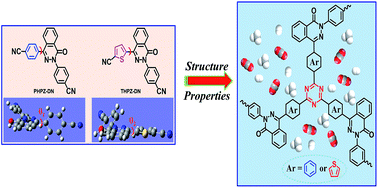
In this work, new classes of phthalazinone-based covalent triazine frameworks (PHCTFs) were prepared by ionothermal synthesis from two full rigid dicyano building blocks with rigid, thermostable and asymmetric N-heterocycle-containing structures. The surface and internal morphologies of PHCTFs were examined by FE-SEM and TEM. The resultant microporous polymers, PHCTFs, exhibited BET specific surface areas up to 1845 m2 g−1 and a moderately narrow pore size distribution. According to the sorption measurements, the CO2 uptake can be up to 17.1 wt% (273 K/1 bar) and the H2 uptake can be up to 1.92 wt% (77 K/1 bar). Moreover, the initial slopes of the single component gas adsorption isotherms in the low pressure range were used as the gas separation ratios. The obtained polymer networks possess satisfactory CO2/N2 selectivity performance up to 52 and CO2/CH4 selectivity up to 12. Combining the relationship of the structure and performance, it can be concluded that a twisted and non-coplanar topology conformation can be used to improve the porosity of microporous organic polymers. At the same time, the nitrogen- and oxygen-rich characteristics of the phthalazinone core endow the networks with a strong affinity for CO2 and thereby high CO2 adsorption capacity. So the pore structure and chemical composition may play very important roles on the adsorption properties of small gas molecules.
 Please wait while we load your content...


