



Studies on the synthesis and properties of polynitro compounds based on esteryl backbones†

Abstract
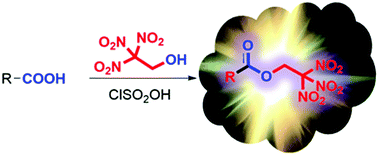
Four esteryl-bridged energetic compounds have been derived from 2,2,2-trinitroethanol with polynitro benzoic acids and characterized via IR, multinuclear NMR spectroscopy, elemental analysis and differential scanning calorimetry (DSC). The structures of 2,2,2-trinitroethyl-2,4,6-trinitrobenzoate (5), bis(2,2,2-trinitroethyl)-4,6-dinitroisophthalate (6), bis(2,2,2-trinitroethyl)-2,5-dinitroterephthalate (7) and bis(2,2,2-trinitroethyl)-2,4,6-trinitroisophthalate (8) were further confirmed by X-ray diffraction studies, which show favorable densities (1.804–1.850 g cm−3). Interestingly, most of the polynitro esters decompose at temperatures over 180 °C (except for 6: 171.6 °C), which thus exhibit good thermal stability. In addition, performance calculations give detonation pressures and velocities for the ester derivatives in the range of 30.4–32.9 GPa and 8267–8559 m s−1, respectively. The esteryl-bridged compounds possess acceptable impact sensitivities (14–22 J), friction sensitivities (240–360 N), and electrostatic sensitivities (0.20–0.32 J). These values indicate that polynitro esters can be candidates as promising energetic materials.
 Please wait while we load your content...


