


 PLATFORM UPDATE:

Low temperature hydrothermal synthesis mechanism and thermal stability of p-type CuMnO2 nanocrystals
 *ab
*ab
Abstract
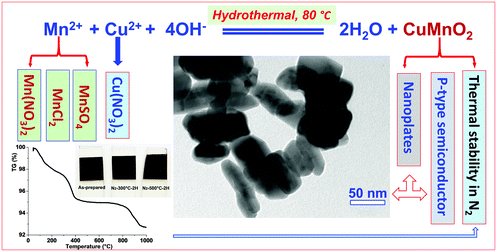
We first report an oxidation–reduction reaction mechanism for the hydrothermal synthesis of CuMnO2 nanocrystals at the low temperature of 80 °C. In detail, CuMnO2 nanocrystals with 50–100 nm size could be obtained based on a hydrothermal reaction from the starting materials of Cu(NO3)2, Mn(NO3)2/MnCl2/MnSO4 and NaOH at 80 °C for 24 h. During the hydrothermal reaction, Cu2+ was reduced to Cu+ and Mn2+ was oxidized to Mn3+, and finally CuMnO2 nanocrystals formed. The TGA analysis indicates the studied CuMnO2 was stable in a N2 atmosphere and the CuMnO2 remained unchanged at a high sintering temperature (500 °C). Moreover, the Mott–Schottky plot results demonstrate that CuMnO2 nanocrystals show p-type semiconductor behaviour. The flat band potential (Efb) position and carrier density of the CuMnO2 nanocrystals are 0.28 V vs. reversible hydrogen electrode (RHE) and 2.46 × 1018 cm−3, respectively. After the CuMnO2 nanocrystals were sintered at 300 °C in N2, the Efb position shows a negative shift to 0.23 V vs. RHE and the carrier density increased to 1.58 × 1019 cm−3. This quick and facile method opens a new route for the preparation of other delafossite oxides, which can be used in some optoelectronic devices such as photoelectrochemical cells and photovoltaic cells.
 Please wait while we load your content...


