


 PLATFORM UPDATE:


In situ growth of sulfide/g-C3N4 nano-heterostructures with an adjusted band gap toward enhanced visible photocatalysis
Abstract
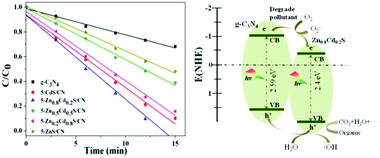
In this study, the nano-heterostructures of Zn1−xCdxS (0 < x < 1) nanoparticles and small g-C3N4 nanosheets (Zn1−xCdxS/CN) were prepared via in situ growth. Bulk g-C3N4 was first delaminated into thin layers by an acid and alkali assisted ultrasound method. Zn1−xCdxS nanoparticles were deposited on the surface of small g-C3N4 nanosheets in situ to fabricate Zn1−xCdxS/CN photocatalysts. The absorption band edges of the as-prepared Zn1−xCdxS/CN composites shifted to a longer wavelength region compared to g-C3N4. The Zn1−xCdxS/CN heterojunctions revealed super-enhanced visible-light photocatalytic activities compared to pure g-C3N4 and Zn1−xCdxS nanoparticles. To investigate the composition dependence, the mass ratios of Zn1−xCdxS and g-C3N4 were adjusted. Zn0.8Cd0.2S nanoparticles (5 wt%) grown in situ on g-C3N4 nanosheets as sample 5-Zn0.8Cd0.2S/CN revealed a very high photocatalytic activity compared to other Zn0.8Cd0.2S/CN and CdS/CN samples where the degradation of RhB was up to 99% within 15 min under visible light irradiation. This was ascribed to the well-matched band gap structure, large specific surface area and intimately contacted interfaces. The controllable band gap of the Zn1−xCdxS/CN composites was a key factor for their enhanced photocatalytic performance. In addition, O2− was the leading reactive oxidative species in this photocatalytic process in the 5-Zn0.8Cd0.2S/CN composite system.
 Please wait while we load your content...


