



Carbon microtube/graphene hybrid structures for thermal management applications†
Abstract
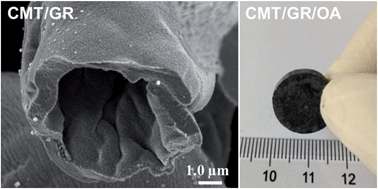
Carbon microtube/graphene (CMT/GR) hybrid structures were prepared from a natural biomass material (absorbent cotton) by the carbonization and continuous chemical vapour deposition (CVD) of graphene at 1200 °C. The graphene nanosheets deposited by CVD had a few-layer structure and were uniformly coated on the surface of the CMTs. The CMT/GR composite had a hollow tubular structure, a specific surface area of about 312 m2 g−1 and was highly hydrophobic (contact angle about 128°). The CMT/GR hybrid acted as a thermally conductive supporting framework and organic octadecanoic acid (OA) was easily impregnated into the CMT/GR structure by capillary forces. The CMT/GR/OA composite had a thermal conductivity of about 0.69 W m−1 K−1 at a CMT/GR loading fraction of about 10 wt%, which is about 4.3 times larger than that of OA (about 0.16 W m−1 K−1). The CMT/GR/OA composite had a high heat storage capacity of about 174 J g−1, very close to the value of OA (about 186 J g−1) and showed good thermal reliability even after 500 melting/freezing cycles. This method produces novel shape-stabilized phase change materials for use in thermal energy storage applications and has given new insights into the design and preparation of CMT/GR hybrid structures from natural resources.
 Please wait while we load your content...


