


 PLATFORM UPDATE:

How does the silicon element perform in JD-dyes: a theoretical investigation†
Abstract
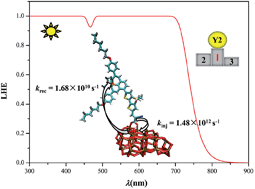
Inspired by the successful utilization of silicon cores axially coordinated by trihexylsiloxy groups in naphthalo/phthalocyanine dyes, using ullazine-based dye JD21 as the prototype, we designed three novel silicon-core JD analogues in this work. Based on the theoretical analysis on the four dyes and the corresponding dye/(TiO2)38 complexes, the Y2 dye with the dithienosilole (DTS) conjugation unit is recognized as a star molecule for its impressive performance in various aspects, including remarkable light-harvesting capability, large driving force for dye regeneration (ΔGreg = 0.65 eV), excellent balance between the rates of electron injection (kinj = 1.48 × 10¹² s−1) and electron–hole recombination (krec = 1.68 × 10¹⁰ s−1), and high stability for the adsorbed system Y2/(TiO2)38. It is thus proposed as a promising candidate for application in dye-sensitized solar cells (DSCs).
 Please wait while we load your content...


