


 PLATFORM UPDATE:


A silica nanoparticle supported fluorescence “turn-on” fluoride ion sensing system with tunable structure and sensitivity†
Abstract
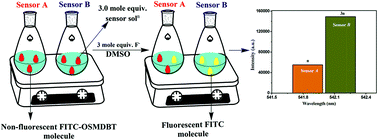
Amino-silane modified silica nanoparticles (SNP-APTMS and SNP-TMSPEDA) doped with silyl-ether protected fluorescein isothiocyanate (FITC-OSMDBT) were synthesized via a sol–gel method in a simple three-step reaction to give fluoride ion probes SNP-TMSPEDA-FITC-OSMDBT (sensor A) and SNP-APTMS-FITC-OSMDBT (sensor B). The sensors were characterized using FT-IR, EDX, TGA, and fluorescence spectroscopy. It was observed that, at fluoride ion and FITC-OSMDBT mole equivalent titration ratio of x : x, the emission spectra of both sensors were similar when x = 1.0; however, at x = 3.0, 6.0, and 9.0, sensor B displayed 3 fold the emission intensity of sensor A. This phenomenon was attributed to non-radiative emission energy transfer mechanisms, which were controlled by the FITC-OSMDBT loading. The steric hindrance difference present on N-[3-(trimethoxysilyl) propyl] ethylenediamine (TMSPEDA) and (3-aminopropyl)trimethoxysilane (APTMS) ensured that different amounts of FITC-OSMDBT were loaded on each sensor. At x = 3.0, 6.0, and 9.0, the emission intensity increased linearly with [F−] in DMSO; thus, from the working curve of sensor A, the fluoride ion detection range of sensor B could be calculated and vice versa. The structure of the sensing system being proposed is simple, sensitive to F−, and may prove useful with respect to the development of fluoride anion sensors with structures which can be easily modified to produce sensors with varying detection ranges.
 Please wait while we load your content...


