


 PLATFORM UPDATE:


Copper coordinated ligand thioether-S and NO2− oxidation: relevance to the CuM site of hydroxylases†
Abstract
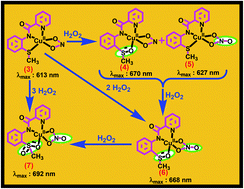
In order to gain insight into the coordination site and oxidative activity of the CuM site of hydroxylases such as peptidylglycine α-hydroxylating monooxygenase (PHM), dopamine β-monooxygenase (DβM), and tyramine β-monooxygenase (TβM), we have synthesized, characterized and studied the oxidation chemistry of copper complexes chelated by tridentate N2Sthioether, N2Osulfoxide or N2Osulfone donor sets. The ligands are those of N-2-methylthiophenyl-2′-pyridinecarboxamide (HL1), and the oxidized variants, N-2-methylsulfenatophenyl-2′-pyridinecarboxamide (HL1SO), and N-2-methylsulfinatophenyl-2′-pyridinecarboxamide (HL1SO2). Our studies afforded the complexes [(L1)CuII(H2O)](ClO4)·H2O (1·H2O), {[(L1SO)CuII(CH3CN)](ClO4)}n (2), [(L1)CuII(ONO)] (3), [(L1SO)CuII(ONO)]n (4), [(L1)CuII(NO3)]n (5), [(L1SO)CuII(NO3)]n (6) and [(L1SO2)CuII(NO3)] (7). Complexes 1 and 3 were described in a previous publication (Inorg. Chem., 2013, 52, 11084). The X-ray crystal structures revealed either distorted octahedral (in 2, 4–6) or square-pyramidal (in 1, 3) coordination geometry around CuII ions of the complexes. In the presence of H2O2, conversion of 1 → 2, 3–5 → 6 and 6 → 7 occurs quantitatively via oxidation of thioether-S and/or Cu(II) coordinated NO2− ions. Thioether-S oxidation of L1 also occurs when [L1]− is reacted with [CuI(CH3CN)4](ClO4) in DMF under O2, albeit low in yield (20%). Oxidations of thioether-S and NO2− were monitored by UV-Vis spectroscopy. Recovery of the sulfur oxidized ligands from their metal complexes allowed for their characterization by elemental analysis, 1H NMR, FTIR and mass spectrometry.
 Please wait while we load your content...


