


 PLATFORM UPDATE:

Terbium doped SnO2 nanoparticles as white emitters and SnO2:5Tb/Fe3O4 magnetic luminescent nanohybrids for hyperthermia application and biocompatibility with HeLa cancer cells†
Abstract
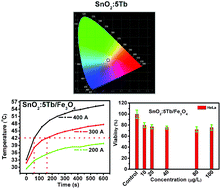
SnO2:5Tb (SnO2 doped with 5 at% Tb3+) nanoparticles were synthesised by a polyol method and their luminescence properties at different annealing temperatures were studied. Characterization of nanomaterials was done by X-ray diffraction (XRD), Fourier transformation infrared spectroscopy (FTIR), transmission electron microscopy (TEM) and vibrating sample magnetometry (VSM). XRD studies indicate that the prepared nanoparticles were of tetragonal structures. Upon Tb3+ ion incorporation into SnO2, Sn4+ changes to Sn2+ and, on annealing again at higher temperature, Sn2+ changes to Sn4+. The prepared nanoparticles were spherical in shape. Sn–O vibrations were found from the FTIR studies. In photoluminescence studies, the intensity of the emission peaks of Tb3+ ions increases with the increase of annealing temperature, and emission spectra lie in the region of white emission in the CIE diagram. CCT calculations show that the SnO2:5Tb emission lies in cold white emission. Quantum yields up to 38% can be obtained for 900 °C annealed samples. SnO2:5Tb nanoparticles were well incorporated into the PVA polymer and such a material incorporated into the polymer can be used for display devices. The SnO2:5Tb/Fe3O4 nanohybrid was prepared and investigated for hyperthermia applications at different concentrations of the nanohybrid. This achieves a hyperthermia temperature (42 °C) under an AC magnetic field. The hybrid nanomaterial SnO2:5Tb/Fe3O4 was found to exhibit biocompatibility with HeLa cells (human cervical cancer cells) at concentrations up to 74% for 100 μg L−1. Also, this nanohybrid shows green emission and thus it will be helpful in tracing magnetic nanoparticles through optical imaging in vivo and in vitro application.
 Please wait while we load your content...


