


 PLATFORM UPDATE:

Evidence of “new hot spots” from determining the nonlinear optical behavior of materials: mechanistic studies of the vanadium borate crystal, Na3VO2B6O11†
Abstract
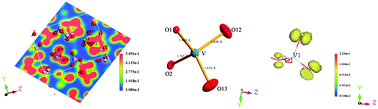
A novel mechanism for the nonlinear optical (NLO) effects of vanadium borate crystals, Na3VO2B6O11 (NVB), with distorted VO4 groups was investigated. A comprehensive analysis of the structure–property relationship was performed by combining the experimental measurements, the electronic structures calculations, the SHG-weighted electron density and the real-space atom-contribution analysis to yield the linear and nonlinear optical properties. The contribution of a (VO4)3− anionic group to the second harmonic generation (SHG) response was more pronounced than that of the (BO3)3− anionic group, which plays a virtual role in the SHG effects in NVB. The anionic (BO3)3− groups make dominant contributions to the birefringence, whereas the contribution of the V5+ cations to these linear optical effects is negligible.
 Please wait while we load your content...


