


 PLATFORM UPDATE:


A novel aptasensor based on single-molecule force spectroscopy for highly sensitive detection of mercury ions
Abstract
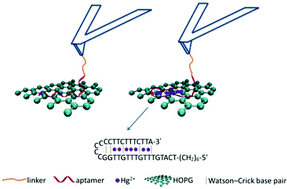
We have developed a novel aptasensor based on single-molecule force spectroscopy (SMFS) capable of detecting mercury ions (Hg2+) with sub-nM sensitivity. The single-strand (ss) DNA aptamer used in this work is rich in thymine (T) and readily forms T–Hg2+–T complexes in the presence of Hg2+. The aptamer was conjugated to an atomic force microscope (AFM) probe, and the adhesion force between the probe and a flat graphite surface was measured by single-molecule force spectroscopy (SMFS). The presence of Hg2+ ions above a concentration threshold corresponding to the affinity constant of the ions for the aptamer (about 5 × 10⁹ M−1) could be easily detected by a change of the measured adhesion force. With our chosen aptamer, we could reach an Hg2+ detection limit of 100 pM, which is well below the maximum allowable level of Hg2+ in drinking water. In addition, this aptasensor presents a very high selectivity for Hg2+ over other metal cations, such as K+, Ca2+, Zn2+, Fe2+, and Cd2+. Furthermore, the effects of the ionic strength and loading rate on the Hg2+ detection were evaluated. Its simplicity, reproducibility, high selectivity and sensitivity make our SMFS-based aptasensor advantageous with respect to other current Hg2+ sensing methods. It is expected that our strategy can be exploited for monitoring the pollution of water environments and the safety of potentially contaminated food.
 Please wait while we load your content...


