


 PLATFORM UPDATE:

Processing-dependence and the nature of the blue-shift of Bi3+-related photoemission in ScVO4 at elevated temperatures
Abstract
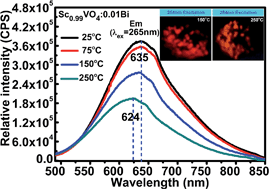
We report on the mechanism of photoemission from Bi3+-related centers in ScVO4. In this material, an unusually strong red photoluminescence was recently observed and was related to hypothetic interactions between oxygen vacancies and Bi3+ species, denoted as oxygen vacancy perturbation. Here, we provide further experimental evidence for the existence of an interrelation between the availability of oxygen and the blue-shift of Bi3+ photoluminescence. For this, the effect of preparation conditions and the temperature-dependence of the spectroscopic properties of ScVO4:Bi3+ are studied. Under a reducing atmosphere, as a result of vanadate reduction from V5+ to V3+, a structural change occurs at high temperature from ScVO4 to ScVO3. However, this transition is avoided through mild treatment for short times. Then, instead of a crystallographic change, different types of defects, which assumedly partition in the vicinity of the Bi3+ dopants, could be locally generated at the expense of oxygen vacancies. As a result, Bi3+ luminescence occurs at higher energy. Similar but considerably smaller blue-shift is confirmed due to thermal inversion from 3P0 to 3P1 because the Bi3+ photoluminescence was measured at elevated temperature. On the basis of these results, we believe that the careful engineering of the local defect environment around Bi3+ and the distribution between the excited states of 3P0 and 3P1 can tailor the spectral properties of future Bi3+-based phosphor materials.
 Please wait while we load your content...


