


 PLATFORM UPDATE:

Luminescent properties of milk carbon dots and their sulphur and nitrogen doped analogues†
Abstract
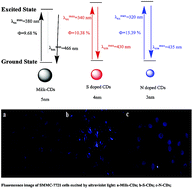
Carbon dots (CDs) and their L-cysteine (S doped CDs) and urea (N doped CDs) doped analogues were made by using the simple and low cost carbon source – pure milk. Milk-CDs have an average diameter of about 5 ± 0.27 nm, whereas S doped CDs and N doped CDs have an average diameter of about 4 ± 0.07 nm and 3 ± 0.07 nm, respectively. The effects of the L-cysteine and urea doping on the spectroscopic and photophysical properties compared with Milk-CDs were studied by means of UV/vis absorption, steady-state, and time-resolved fluorometry. The maxima fluorescence excitation of S doped CDs and N doped CDs are blue-shifted by 40 and 60 nm and fluorescence emission maxima are blue shifted by 36 and 30 nm, respectively compared with those of the Milk-CDs. Furthermore, the excitation maxima of the up-conversion fluorescence emission (anti-Stokes) of N doped CDs are blue-shifted by 90 nm and emission maxima are blue shifted by 50 nm compared with those of the Milk-CDs and S doped CDs, respectively. N doped CDs have the highest fluorescence quantum yield among the three CDs. Moreover, the confocal microscopy experiments showed that the Milk-CDs, S doped CDs and N doped CDs can be used within living cells.
 Please wait while we load your content...


