


 PLATFORM UPDATE:

Oxidative stability and reaction mechanism of lithium bis(oxalate)borate as a cathode film-forming additive for lithium ion batteries
Abstract
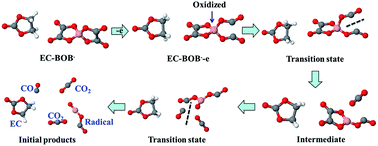
The oxidative decomposition mechanism of lithium bis(oxalate)borate (LiBOB) as a cathode film-forming additive has been investigated using density functional theory calculations at the B3LYP/6-311++G(d) level, with the polarized continuum model. The calculated oxidation potentials of the investigated structures decreased in the following order: carbonate (including isolate EC, PC and DMC) > BOB− (isolate) ≈ carbonate–BOB− clusters. Charge distribution results show that the electron of the oxidized carbonate–BOB− cluster was taken from BOB−, indicating the higher oxidation activity of BOB−. Decomposition mechanism analyses of the EC–BOB−-e cluster indicate that breakage of the BOB− structure is more energetically favorable than EC. The most likely reaction path of this cluster is the ring opening reaction of BOB− via two transition states, generating CO, CO2 and radical R1 which may further terminate generating a borate-containing oligomer. This oligomer is believed to play a crucial role in suppressing further oxidative decomposition of carbonate solvents.
 Please wait while we load your content...


