


 PLATFORM UPDATE:

Solid-state colloidal CuInS2 quantum dot solar cells enabled by bulk heterojunctions†
Abstract
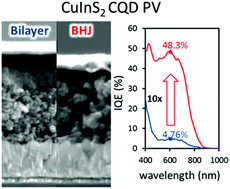
Colloidal copper indium sulfide (CIS) nanocrystals (NCs) are Pb- and Cd-free alternatives for use as absorbers in quantum dot solar cells. In a heterojunction with TiO2, non-annealed ligand-exchanged CIS NCs form solar cells yielding a meager power conversion efficiency (PCE) of 0.15%, with photocurrents plummeting far below predicted values from absorption. Decreasing the amount of zinc during post-treatment leads to improved mobility but marginal improvement in device performance (PCE = 0.30%). By incorporating CIS into a porous TiO2 network, we saw an overall drastic improvement in device performance, reaching a PCE of 1.16%, mainly from an increase in short circuit current density (Jsc) and fill factor (FF) and a 10-fold increase in internal quantum efficiency (IQE). We have determined that by moving from a bilayer to a bulk heterojunction architecture, we have reduced the trap-assisted recombination as seen in changes in the ideality factor, the intensity dependence of the photocurrent and transient photocurrent (TPC) and photovoltage (TPV) characteristics.
 Please wait while we load your content...


