


 PLATFORM UPDATE:

Boronic acid functionalized magnetic nanoparticles via thiol–ene click chemistry for selective enrichment of glycoproteins
Abstract
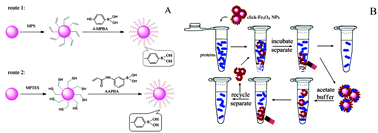
A simple, novel approach was developed for the preparation of boronic acid functionalized Fe3O4 magnetic nanoparticles (MNPs) via thiol–ene (TE) click reaction. In this work, two clickable Fe3O4 MNPs functionalized with either alkene or thiol moieties were synthesized. Firstly, Fe3O4 MNPs were synthesized through a solvothermal method and then the clickable alkene- or thiol-coated Fe3O4 MNPs were prepared by sol–gel reaction with an organosilicon coupling agent, 3-(methacryloyloxy) propyltrimethoxylsilane (MPS) or 3-mercaptopropyltriethoxysilane (MPTES). The carbon–carbon double bonds/thiol groups on the surface of the MNPs serve as clickable sites to react with 4-mercaptophenylboronic acid (4-MPBA)/3-acrylamidophenylboronic acid (AAPBA) during the subsequent TE click reaction. Finally, the high density of boronic acid ligands immobilized on the surface of the Fe3O4 MNPs was obtained via TE click reactions. The morphology, adsorption and recognition properties of the Fe3O4 MNPs were investigated by transmission electron microscopy (TEM), scanning electron microscopy (SEM), X-ray diffraction (XRD), vibrating sample magnetometry (VSM) and X-ray photoelectron spectrometry (XPS). Four proteins, including ovalbumin (OB) and transferrin (Trf) as glycoprotein templates, and lysozyme (Lyz) and horse heart cytochrome c (Cyt C) as non-glycoprotein templates are chosen as target proteins. Two types of click-Fe3O4 MNP (Fe3O4@MPS@PBA and Fe3O4@SH@AAPBA) exhibit a high binding capacity and excellent specificity towards glycoproteins, and can selectively capture and separate glycoproteins from egg white samples directly. Furthermore, this work could provide a promising method of surface modification for the design of more efficient adsorbents for the isolation and enrichment of proteins from complex bio-samples.
 Please wait while we load your content...


