


 PLATFORM UPDATE:

Towards the use of ICP-OES for the elemental analysis of organic compounds such as glucosamine
Abstract
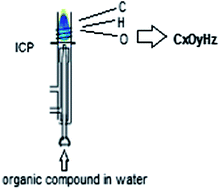
Inductively coupled plasma optical emission spectrometry with a long demountable torch (whose outer tube is 2.5 cm longer than a standard torch) and a conventional pneumatic nebulisation system was applied to the determination of C, H and O concentrations from an organic compound dissolved in water. The sample solution was simply aspirated directly into the plasma without any sample pre-treatment (such as desolvation or degassing). The long torch was required to significantly decrease the background arising from entrained air. Good linearity was obtained for C, N, H and O upon calibration with standard solutions prepared from ultrapure tris(hydroxymethyl)aminomethane. A weighed blank correction was applied to compensate for the contribution from water, especially in the cases of H and O. Under these conditions, the detection limits for C, N, H and O were, respectively, 0.2, 50, 1000 and 2000 μmol of analyte per g of solution. Accurate concentrations, according to a Student's t test at the 95% confidence level, were measured for C, H and O in a solution of D-glucosamine hydrochloride. No internal standardisation was necessary. However, the N concentration was biased high, irrespectively of the N emission line used (from 149.262 to 593.178 nm), which rules out spectroscopic interference and will be further investigated. Nonetheless, the possibility of accurately determining C, H and O simultaneously with trace elements makes the approach quite promising. It is much simpler than alternate methods that require derivatisation of the compound prior to detection.
 Please wait while we load your content...


