


 PLATFORM UPDATE:


Dimethylsilyl bis(amidinate)actinide complexes: synthesis and reactivity towards oxygen containing substrates†
Abstract
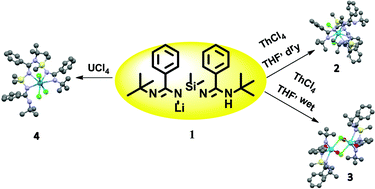
The reactivity of the monoanionic amidinate ligand [(CH3)3CNC(Ph)NSiMe2NC(Ph)–NHC(CH3)3]Li (1) with a silyl amido side arm towards the early actinides, uranium and thorium, was investigated. While the salt metathesis reaction with ThCl4(thf)3 afforded the bis(amidinate)thorium(IV) dichloride complex [(CH3)3CNC(Ph)NSi(CH3)2NC(Ph)–NHC(CH3)3]ThCl2 (2) in high yield, the reaction of ligand 1 with UCl4 leads to a Lewis acid supported nucleophilic attack of an incoming ligand unit, yielding the trichloro uranium complex [(CH3)3CNC(Ph)Si(CH3)2–N(C(CH3)3)C(Ph)NSi(CH3)2NC(Ph)N–(C(CH3)3]UCl3 (4). The exposure of in situ formed complex 2 to wet THF solutions (<1% w of water), gave the mono(amidinate)Th(IV)(chloro)(bis-hydroxo) dimeric complex [(CH3)3CNC(Ph)NSiMe2NC(Ph)NHC(CH3)3Th(OH)2(Cl)]2·(3) as bright red needles, exhibiting extremely short Th–OH bond distances (1.741(5) Å and 1.737(5) Å). The reactivity of the thorium complex 2 in the ring opening polymerization (ROP) was studied, showing high activity. Thermodynamic and kinetic measurements were performed to shed light on the mechanism for the ROP.
 Please wait while we load your content...


