Jump to main content
Jump to site search

Issue 5, 2014
Previous Article Next Article

The Houk–List transition states for organocatalytic mechanisms revisited

Author affiliations

Abstract

The ten year old Houk–List model for rationalising the origin of stereoselectivity in the organocatalysed intermolecular aldol addition is revisited, using a variety of computational techniques that have been introduced or improved since the original study. Even for such a relatively small system, the role of dispersion interactions is shown to be crucial, along with the use of basis sets where the superposition errors are low. An NCI (non-covalent interactions) analysis of the transition states is able to identify the noncovalent interactions that influence the selectivity of the reaction, confirming the role of the electrostatic NCHδ+⋯Oδ interactions. Simple visual inspection of the NCI surfaces is shown to be a useful tool for the design of alternative reactants. Alternative mechanisms, such as proton-relays involving a water molecule or the Hajos–Parrish alternative, are shown to be higher in energy and for which computed kinetic isotope effects are incompatible with experiment. The Amsterdam manifesto, which espouses the principle that scientific data should be citable, is followed here by using interactive data tables assembled via calls to the data DOI (digital-object-identifiers) for calculations held on a digital data repository and themselves assigned a DOI.
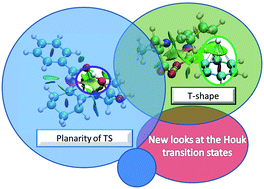
Graphical abstract: The Houk–List transition states for organocatalytic mechanisms revisited

Back to tab navigation

Supplementary files

Article information


Submitted
12 Dec 2013
Accepted
24 Feb 2014
First published
24 Feb 2014

This article is Open Access
All publication charges for this article have been paid for by the Royal Society of Chemistry

Chem. Sci., 2014,5, 2057-2071
Article type
Edge Article
Author version available

The Houk–List transition states for organocatalytic mechanisms revisited

A. Armstrong, R. A. Boto, P. Dingwall, J. Contreras-García, M. J. Harvey, N. J. Mason and H. S. Rzepa, Chem. Sci., 2014, 5, 2057
DOI: 10.1039/C3SC53416B

This article is licensed under a Creative Commons Attribution 3.0 Unported Licence. Material from this article can be used in other publications provided that the correct acknowledgement is given with the reproduced material.

Reproduced material should be attributed as follows:

  • For reproduction of material from NJC:
    [Original citation] - Published by The Royal Society of Chemistry (RSC) on behalf of the Centre National de la Recherche Scientifique (CNRS) and the RSC.
  • For reproduction of material from PCCP:
    [Original citation] - Published by the PCCP Owner Societies.
  • For reproduction of material from PPS:
    [Original citation] - Published by The Royal Society of Chemistry (RSC) on behalf of the European Society for Photobiology, the European Photochemistry Association, and RSC.
  • For reproduction of material from all other RSC journals:
    [Original citation] - Published by The Royal Society of Chemistry.

Information about reproducing material from RSC articles with different licences is available on our Permission Requests page.


Social activity

Search articles by author

Spotlight

Advertisements