


 PLATFORM UPDATE:

Co3O4 nanostructures: the effect of synthesis conditions on particles size, magnetism and transport properties
Abstract
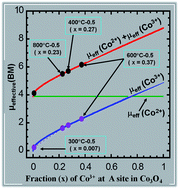
Surfactant-free Co3O4 nanostructures with various particle size ranges were synthesized via the solution combustion method using cobalt nitrate solution as a cobalt precursor and urea as a combustion fuel. Control over average particles size range was achieved by tuning the reaction ignition temperature between 300 °C and 800 °C. X-ray diffraction (XRD) and helium gas pycnometry indicated the formation of single phase Co3O4 nanoparticles with a spinel structure. Transmission electron microscopy (TEM) studies revealed an increase of the size range from 5–8 nm to 200–400 nm for Co3O4 nanoparticles synthesized at 300 °C and 800 °C, respectively. The corresponding decrease in the specific surface area from 39 m2 g−1 to ∼2 m2 g−1 was confirmed by gas adsorption analysis using BET techniques. Magnetic susceptibility measurements revealed a dominant antiferromagnetic (AFM) ordering and the Néel temperature decreases with a decreasing average particle size range from 31 K (200–400 nm) to 25 K (5–18 nm). Interestingly, effective magnetic moments (ranging from 4.12 μB to 6.16 μB) substantially larger than the value of 3.9 μB expected for Co2+ ions in the normal spinel structure of Co3O4 were extracted from the inverse susceptibility data. This finding was rationalized by taking into account the disordered distribution of Co2+ and Co3+ ions in the Co3O4 inverse spinel structures ([(Co2+)1−x(Co3+)x]tet[(Co2+)x(Co3+)2−x]octO4) where the inversion degree (x) depends on the synthesis temperature. Transport measurements using hot pressed pellets of Co3O4 nanoparticles indicated p-type semiconducting behavior and drastic reductions in the thermal conductivity with decreasing average particle size.
 Please wait while we load your content...


