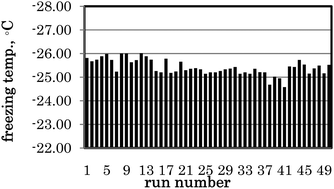
Ice repellent coatings have been studied and keenly sought after for many years, where any advances in the durability of such coatings will result in huge energy savings across many fields. Progress in creating anti-ice and anti-frost surfaces has been particularly rapid since the discovery and development of slippery, liquid infused porous surfaces (SLIPS). Here we use SLIPS-coated differential scanning calorimeter (DSC) pans to investigate the effects of the surface modification on the nucleation of supercooled water. This investigation is inherently different from previous studies which looked at the adhesion of ice to SLIPS surfaces, or the formation of ice under high humidity conditions. Given the stochastic nature of nucleation of ice from supercooled water, multiple runs on the same sample are needed to determine if a given surface coating has a real and statistically significant effect on the nucleation temperature. We have cycled supercooling to freezing and then thawing of deionized water in hydrophilic (untreated aluminum), hydrophobic, superhydrophobic, and SLIPS-treated DSC pans multiple times to determine the effects of surface treatment on the nucleation and subsequent growth of ice. We find that SLIPS coatings lower the nucleation temperature of supercooled water in contact with statistical significance and show no deterioration or change in the coating performance even after 150 freeze–thaw cycles.
You have access to this article
 Please wait while we load your content...
Something went wrong. Try again?
Please wait while we load your content...
Something went wrong. Try again?