Lite Version|Standard version

To gain access to this content please
Log in via your home Institution.
Log in with your member or subscriber username and password.
Download

The temperature dependence of the phase behavior of the TODGA-based water in oil (w/o) microemulsions in dodecane has been investigated by dynamic light scattering (DLS) and viscometry techniques. These microemulsions have been found to undergo phase separation into dilute and concentrated reverse micellar solutions at their respective upper consolute temperatures (UCTs). DLS and viscometry studies attribute this to a progressive strengthening of the inter-micellar attractive interaction with decrease in temperature. The UCT of these microemulsions has been found to increase quite significantly with increase in the aqueous HNO3 concentration due to an enhancement in the inter-micellar attractive interaction. Besides identifying the existence of an upper consolute temperature in this system, we have also observed that these reverse micellar solutions show critical behavior in the form of divergence of the apparent hydrodynamic size of the reverse micelles on approaching the UCT. Viscometry studies and their modeling based on Baxter adhesive hard sphere theory suggest that the stickiness parameter of the reverse micellar aggregates in this system remains much lower than the critical value (τc−1 ≈ 10.25) on approaching the UCT. This suggests that the observed phase separation in these microemulsions cannot be explained based on a gas–liquid type phase transition.
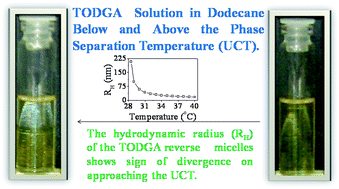
Graphical abstract: Phase separation in the TODGA reverse micellar solutions in dodecane: identifying an upper consolute temperature and an associated critical behavior

Page: ^ Top