Lite Version|Standard version

To gain access to this content please
Log in with your free Royal Society of Chemistry publishing personal account.
Log in via your home Institution.
Log in with your member or subscriber username and password.
Download

The plasma concentration of HDL-C and the prevalence of coronary heart disease (CHD) is inversely related. Inhibition of cholesteryl ester transfer protein (CETP) is considered to be a potential approach to treat dyslipidemia and CHD. 2-arylbenzoxazoles were found to be a potential class of CETP inhibitors. A 2D QSAR study was done on a series of 2-arylbenzoxazoles using PCR, PLS and MLR techniques and externally validated to determine significant models. kNN-MFA 3D QSAR was performed on the same series to correlate the effects of electrostatic, steric and hydrophobic parameters with the CETP inhibitory activity using forward backward regression, genetic algorithm and simulated annealing methods. Pharmacophore mapping was also done on the conformers of the 2-arylbenzoxazoles generated by the BEST and the FAST method. This work may provide a platform for generating leads for novel CETP inhibitors.
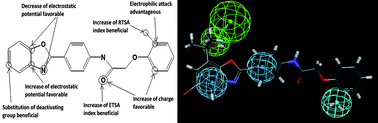
Graphical abstract: Chemometric modeling and pharmacophore mapping in coronary heart disease: 2-arylbenzoxazoles as cholesteryl ester transfer protein inhibitors

Page: ^ Top