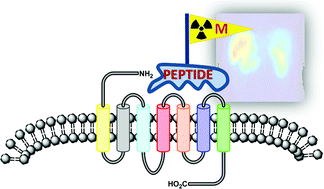
In developed countries, cancer is the second leading cause of death, being only surpassed by cardiovascular diseases. To develop tumor-targeted tools to localize and treat cancer at an early stage is a multidisciplinary area fuelled by the convergence of biology, medicine, chemistry, physics and engineering. Chemists, in particular, play a critical role in this effort, as they are continuously challenged to use innovative chemical strategies to develop ‘smart drugs’. The in vitro observation that peptide receptors are overexpressed in certain tumors, as compared to endogenous expression levels, has prompted the use of such receptors as targets and the design of radiolabelled peptide-based tools for targeted nuclear molecular imaging and therapy. Such approach has gained increased interest over the last two decades, driven in particular by the success of OctreoScan® and by the increasing knowledge concerning overexpression of regulatory peptide receptors in tumor tissues. Selected peptides that target a variety of disease related receptors are in place and have been labeled with different radiometals, using mainly the bifunctional approach. This review begins by summarizing some relevant aspects of the coordination chemistry of the metals studied for labeling peptides. Then, we provide an overview of the chemical strategies explored to improve the biological performance of different families of radiometallated peptides for nuclear molecular imaging and/or targeted radionuclide tumor therapy.
You have access to this article
 Please wait while we load your content...
Something went wrong. Try again?
Please wait while we load your content...
Something went wrong. Try again?


 PLATFORM UPDATE: