


 PLATFORM UPDATE:

Achieving maximum photo-oxidation reactivity of Cs0.68Ti1.83O4−xNx photocatalysts through valence band fine-tuning
Abstract
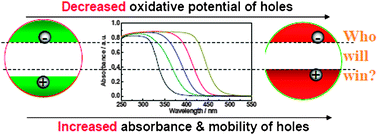
Does a wider absorption range of the photocatalyst always result in a higher photoreactivity? By investigating a set of Cs0.68Ti1.83O4−xNx (x = 0–0.31) photocatalysts with a continuously tuned absorption edge, we found that although the absorption edge of Cs0.68Ti1.83O4−xNx is gradually shifted to the low-energy region with the increase of the
 Please wait while we load your content...


