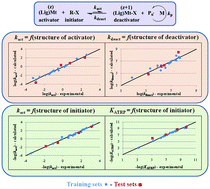
In this work, we present the first successful application of in silico modeling to the construction of quantitative and predictive relationships between the set of constants kact, kdeact and KATRP and the structures and properties of various ATRP catalysts and initiators. The results are consistent not only with the generally accepted ATRP mechanistic picture but also provide valuable insights into this complex polymerization reaction. The models, built using the genetic function approximation algorithm, highlight and quantify the pivotal roles played in the ATRP process by energetic and steric factors of both catalysts and initiators as well as by the reaction medium. Moreover, the models suggest the existence of long-range interactions in catalyst–initiator recognition and subsequent binding. We believe that the approach will prove to be a powerful tool for the discovery of improved catalysts for ATRP.