Lite Version|Standard version

To gain access to this content please
Log in via your home Institution.
Log in with your member or subscriber username and password.
Download

Self-assembled monolayers of dithiolated neutral monotetraazamacrocyclic complexes of copper(II) and nickel(II) can provide molecularly defined platforms for the formation of a pseudorotaxane-like nanostructures on the gold electrode surface. We propose these complexes as π-donor building blocks for the construction of new molecular devices. We show that these perpendicularly oriented macrocyclic complexes anchored to the electrode surface act as π-electron rich species interacting with π-electron deficient compounds dissolved in solution, such as fluorine derivatives of tetracyanoquinodimethane (F4TCNQ) or a charged bismacrocyclic tetraaza complex of copper(II). The interactions of the surface immobilized macrocyclic complexes with F4TCNQ and with ring-shaped acceptor molecules are monitored and characterized by linear scan voltammetry. The interactions with the bismacrocyclic compound lead to a new pseudorotaxane array supported on the electrode surface and switched on and off by the application of appropriate potentials.
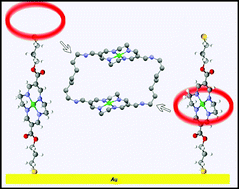
Graphical abstract: Interactions of dithiolated tetraazamacrocyclic copper(ii) and nickel(ii) complexes self-assembled on gold electrodes with π-electron deficient molecules in solution

Page: ^ Top