


 PLATFORM UPDATE:

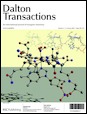
Reactivity of the zwitterionic ligand EtNHC(S)Ph2P![[double bond, length as m-dash]](https://www.rsc.org/images/entities/char_e001.gif) NPPh2C(S)NEt towards [Ru3(CO)12]. Sulfur transfer and ligand fragmentation leading to the methideylamide [-N(Et)-CH(R)-] μ3-bridging moiety†
NPPh2C(S)NEt towards [Ru3(CO)12]. Sulfur transfer and ligand fragmentation leading to the methideylamide [-N(Et)-CH(R)-] μ3-bridging moiety†
Abstract
The reaction of EtNHC(S)Ph2PNP+Ph2C(S)N−Et (HEtSNS) with [Ru3(CO)12] has been carried out under two different experimental conditions: in the first case [Ru3(CO)12], previously turned into the labile intermediate [Ru3(CO)10(CH3CN)2], afforded, at room temperature in PPh2C(S)NEt]} (2), {Ru3(CO)9(μ-H)[(μ-S:κ-P)Ph2PNP(S)Ph2]} (3) and {Ru3(CO)10[(μ-κ2P)Ph2PNHPPh2]} (4). Ligand fragmentation occurs via loss of EtNC or EtNCS, without sulfur transfer to the cluster core. In the second case, [Ru3(CO)12] reacted with HEtSNS in PPh2C(H)NEt]} (5), {Ru3(CO)8)(μ3-S)[(μ2-N:η-C:κ-P)Ph2PNPPh2C(H)NEt]} (6) and {Ru3(CO)6(μ3-CO)(μ3-S)(EtNC)[(μ-κ2P) Ph2PNHPPh2]} (7). The last three compounds derive from ligand fragmentation and sulfur transfer to the metal cluster. All compounds were characterized by PPh2C(S)NEt PPh2C(H)NEt
![Graphical abstract: Reactivity of the zwitterionic ligand EtNHC(S)Ph2P [[double bond, length as m-dash]] NPPh2C(S)NEt towards [Ru3(CO)12]. Sulfur transfer and ligand fragmentation leading to the methideylamide [-N(Et)-CH(R)-] μ3-bridging moiety](/en/Image/Get?imageInfo.ImageType=GA&imageInfo.ImageIdentifier.ManuscriptID=B812050A&imageInfo.ImageIdentifier.Year=2009)
 Please wait while we load your content...

![[double bond, length as m-dash]](https://www.rsc.org/images/entities/h2_char_e001.gif) NPPh2C(S)NEt towards [Ru3(CO)12]. Sulfur transfer and ligand fragmentation leading to the methideylamide [-N(Et)-CH(R)-] μ3-bridging moiety
NPPh2C(S)NEt towards [Ru3(CO)12]. Sulfur transfer and ligand fragmentation leading to the methideylamide [-N(Et)-CH(R)-] μ3-bridging moiety

