


 PLATFORM UPDATE:


Crystal structure prediction for cyclotrimethylene trinitramine (RDX) from first principles†
Abstract
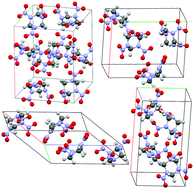
Crystal structure prediction and molecular dynamics methods were applied to the cyclotrimethylene trinitramine (RDX) crystal to explore the stability rankings of various polymorphs using a recently developed nonempirical potential energy function that describes the RDX dimer interactions. The energies of 500 high-density structures resulting from molecular packing were minimized and the 14 lowest-energy structures were subjected to isothermal–isostress molecular dynamics (NsT-MD) simulations. For both crystal structure prediction methods and molecular dynamics simulations, the lowest-energy polymorph corresponded to the experimental structure; furthermore, the lattice energy of this polymorph was lower than that of the other polymorphs by at least 1.1 kcal mol−1. Crystal parameters and densities of the low-energy crystal produced by the NsT-MD simulations matched those of the experimental crystal to within 1% of density and cell edge lengths and 0.01° of the cell angle. The arrangement of the molecules within the time-averaged unit cell were in equally outstanding agreement with experiment, with the largest deviation of the location of the molecular mass centers being less than 0.07 Å and the largest deviation in molecular orientation being less than 2.8°. NsT-MD simulations were also used to calculate crystallographic parameters as functions of temperature and pressure and the results were in a reasonable agreement with experiment.
 Please wait while we load your content...


