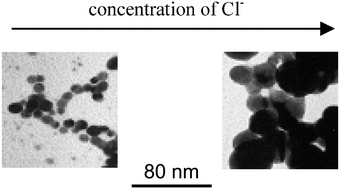
Changes in morphology, surface reactivity and surface-enhancement of Raman scattering induced by modification of borate-stabilized Ag nanoparticles by adsorbed chlorides have been explored using TEM, EDX analysis and SERS spectra of probing adsorbate 2,2′-bipyridine (bpy) excited at 514.5 nm and evaluated by factor analysis. At fractional coverages of the parent Ag nanoparticles by adsorbed chlorides <0.6, the Ag colloid/Cl−/bpy systems were found to be constituted by fractal aggregates of Ag nanoparticles fairly uniform in size (10 ± 2 nm) and SERS spectra of Ag+-bpy surface species were detected. The latter result was interpreted in terms of the presence of oxidized Ag+ and/or Agn+ adsorption sites, which have been encountered also in systems with the chemically untreated Ag nanoparticles. At chloride coverages >0.6, a fusion of fractal aggregates into the compact aggregates of touching and/or interpenetrating Ag nanoparticles has been observed and found to be accompanied by the formation of another surface species, Ag-bpy, as well as by the increase of the overall SERS enhancement of bpy by factor of 40. The same Ag-bpy surface species has been detected under the strongly reducing conditions of reduction of silver nitrate by sodium borohydride in the presence of bpy. The formation of Ag-bpy is thus interpreted in terms of the stabilization of reduced Ag(0) adsorption sites by adsorbed bpy. The formation of reduced adsorption sites on Ag nanoparticle surfaces at chloride coverages >0.6 is discussed in terms of local changes in the work function of Ag. Finally, the SERS spectral detection of Ag-bpy species is proposed as a tool for probing the presence of reduced Ag(0) adsorption sites in systems with chemically modified Ag nanoparticles.
You have access to this article
 Please wait while we load your content...
Something went wrong. Try again?
Please wait while we load your content...
Something went wrong. Try again?