



Matrix isolation and low temperature solid state FTIR spectroscopic study of α-furil†
Abstract
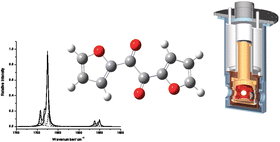
α-Furil [C4H3O–C(![[double bond, length as m-dash]](https://www.rsc.org/images/entities/char_e001.gif) O)–C(O)–C4H3O] has been isolated in argon and xenon matrices and studied by O) fragments nearly planar. The three conformers differ in the orientation of the furan rings relative to the carbonyl groups: the most stable conformer, I (C2 symmetry; OC–CO intercarbonyl dihedral equal to 153.1°), has both furan rings orientated in such a way that one of their β-hydrogen atoms approaches the oxygen atom of the most distant C–C–CO six-membered rings; the second most stable conformer, II (C1 symmetry; OC–CO intercarbonyl dihedral equal to 126.9°), has one furan ring orientated as in I, while the second furan group is rotated by ca. 180° (resulting in an energetically less favourable H–CC–CO five-membered ring); in the third conformer, III (C2 symmetry; OC–CO dihedral equal to 106.2°), both furan rings assume the latter orientation relative to the dicarbonyl group. The theoretical calculations predicted the two higher energy forms being 5.85 and 6.22 kJ mol−1 higher in energy than the most stable form, respectively, and energy barriers for conformational interconversion higher than 40 kJ mol−1. These barriers are high enough to prevent observation of conformational isomerization for the matrix isolated compound. The three possible conformers of
O)–C(O)–C4H3O] has been isolated in argon and xenon matrices and studied by O) fragments nearly planar. The three conformers differ in the orientation of the furan rings relative to the carbonyl groups: the most stable conformer, I (C2 symmetry; OC–CO intercarbonyl dihedral equal to 153.1°), has both furan rings orientated in such a way that one of their β-hydrogen atoms approaches the oxygen atom of the most distant C–C–CO six-membered rings; the second most stable conformer, II (C1 symmetry; OC–CO intercarbonyl dihedral equal to 126.9°), has one furan ring orientated as in I, while the second furan group is rotated by ca. 180° (resulting in an energetically less favourable H–CC–CO five-membered ring); in the third conformer, III (C2 symmetry; OC–CO dihedral equal to 106.2°), both furan rings assume the latter orientation relative to the dicarbonyl group. The theoretical calculations predicted the two higher energy forms being 5.85 and 6.22 kJ mol−1 higher in energy than the most stable form, respectively, and energy barriers for conformational interconversion higher than 40 kJ mol−1. These barriers are high enough to prevent observation of conformational isomerization for the matrix isolated compound. The three possible conformers of
 Please wait while we load your content...


