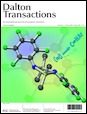
Issue 6, 2005

Formation and dissociation kinetics of Cu(ii) and Ni(ii) complexes with N2S2-macrocycles

Abstract

The kinetics of the formation and dissociation of the Cu2+ and Ni2+ complexes with a series of N2S2 macrocycles, in which the ring size and the geometry of the arrangement of the donor groups have been varied, have been measured at 25 °C and I = 0.5 (KNO3). Both the deprotonated (L) and the monoprotonated (LH+) form of the ligands are reactive species in the formation step. In their deprotonated form, first bond formation, in some cases supported by an ICB effect, is rate determining, independently of the ring size. In the monoprotonated form, we find slower rates, due to the charge repulsion and/or conformation changes induced by hydrogen bonds. In contrast the mechanism of the dissociation is very dependent on the ring size. The complexes with the smaller rings react as flexible open-chain ligands directly with H+. In contrast, the complexes with the larger rings react in a similar way as rigid ligands: first the metal amine bond slowly dissociates so that the free electron pair of the amine can take the “out conformation” and then it is protonated. The 14-membered macrocycle L3 forms complexes in which the metal ions are ideally coordinated so that their dissociation becomes extremely slow.

Graphical abstract: Formation and dissociation kinetics of Cu(ii) and Ni(ii) complexes with N2S2-macrocycles

Article information

Article type
Paper
Submitted
15 Nov 2004
Accepted
27 Jan 2005
First published
15 Feb 2005

Dalton Trans., 2005, 1136-1140

Formation and dissociation kinetics of Cu(II) and Ni(II) complexes with N2S2-macrocycles

L. Siegfried and T. A. Kaden, Dalton Trans., 2005, 1136 DOI: 10.1039/B417405B

To request permission to reproduce material from this article, please go to the Copyright Clearance Center request page.

If you are an author contributing to an RSC publication, you do not need to request permission provided correct acknowledgement is given.

If you are the author of this article, you do not need to request permission to reproduce figures and diagrams provided correct acknowledgement is given. If you want to reproduce the whole article in a third-party publication (excluding your thesis/dissertation for which permission is not required) please go to the Copyright Clearance Center request page.

Read more about how to correctly acknowledge RSC content.

Social activity

Spotlight

Advertisements