


 PLATFORM UPDATE:


Redox state switching of transition metals by deprotonation of the tridentate ligand 2,6-bis(imidazol-2-yl)pyridine†
Abstract
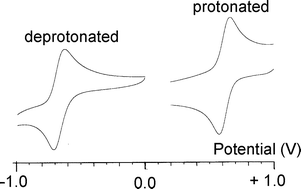
The chemistry of the ligand 1, 2,6-bis(imidazol-2-yl)pyridine with manganese, cobalt, nickel and ruthenium has been investigated. The ligand binds as a meridional tridentate ligand as shown by the crystal structures of [Mn(1)2](CF3SO3)2·Et2O and [Ru(1)2](PF6)2·2CH3CN·H2O. The coordinated ligand is deprotonated in mildly basic solution, and this leads to a drop in the metal M(III)/M(II) reduction potential for cobalt and ruthenium of roughly 1.3 V. The crystal structure of Na2(PPN)[Co(1 − 2H)2]2(OH)·MeOH·2H2O confirms the deprotonation and shows sodium to bind to the deprotonated nitrogen atoms. No stabilisation of the M(III) oxidation state was observed for nickel and manganese.
 Please wait while we load your content...


