


 PLATFORM UPDATE:

New ligand bearing preorganized binding side-arms interacting with ammonium cations: Synthesis, conformational studies and crystal structure†
Abstract
The synthesis and characterization of the new tetraazamacrocycle 4-(N),10-(N)-bis[2-(3-hydroxy-2-oxo-2H-pyridin-1-yl)acetamido]-1,7-dimethyl-1,4,7,10-tetraazacyclododecane (L) is reported. L shows two 3-(hydroxy)-1-(carbonylmethylen)-2(1H)-pyridinone moieties as side-arms of a tetra-aza-macrocyclic base. The key coupling of side-arms was studied and the most significant results were obtained by activating the 3-(benzyloxy)-1-(carboxymethyl)-2(1H)-pyridinone as pentafluorophenol ester. The acid–base properties of L and its capability to interact with simple ammonium cations were investigated by potentiometric measurements in aqueous solution (298.1 ± 0.1 K, I = 0.15 mol dm−3). Protonated species of L can bind NH4+ or primary ammonium cations such as MeNH3+ discriminating them from secondary or tertiary ammonium cations such as Me2NH2+ or Me3NH+ which are not bound in aqueous solution.
1
H and 13C NMR spectra showed the existence in solution of two conformers on the NMR time scale due to the rotational restriction of the two N–C![[double bond, length as m-dash]](https://www.rsc.org/images/entities/char_e001.gif) O groups. The activation parameters were determined by dynamic variable-temperature NMR analysis.
O groups. The activation parameters were determined by dynamic variable-temperature NMR analysis.
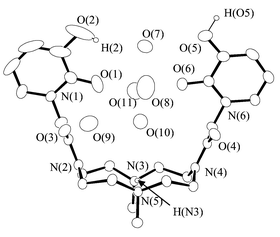
Molecular dynamics calculations gave results in agreement with the experimental data for both conformation and ammonium-binding studies, underlining that the transformation of the two secondary amines of the macrocyclic base to amide functions, forces the side-arms to remain fixed in position, almost face to face and thus to be preorganized to interact with other species. The crystal structure of the [HL]Cl·8H2O species shows the high number of preorganized hydrogen bond sites capable, in this case, of interacting directly with five H2O molecules.
 Please wait while we load your content...


