Lite Version|Standard version

To gain access to this content please
Log in via your home Institution.
Log in with your member or subscriber username and password.
Download

Electrochemical design of silver distribution near the surface or in the bulk of alkali silicate glass for use in the preparation of optical devices was carried out using an ion-conducting microelectrode. The fundamental solid-state electrochemical cell consists of an anode (Ag)/Ag-β″-Al2O3/alkali silicate glass/cathode (Ag) system, where the Ag+ conducting Ag-β″-Al2O3 microelectrode was used as a cationic source. Ag+ in Ag-β″-Al2O3 was substituted for alkali metal cations in the glass during electrolysis. Scanning the Ag-β″-Al2O3 microelectrode under an applied electric field resulted in the fine-patterned Ag-distribution in the glass surface so that the contact radius between Ag-β″-Al2O3 and glass was extremely small (about 10 µm). Furthermore, the patterned Ag distribution, which was constructed near the surface in advance, can be encapsulated within the bulk by subsequent Na+ injection.
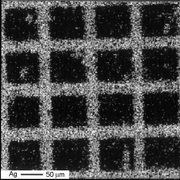
Graphical abstract: Electrochemical design of metal distribution in alkali silicate glass with ion-conducting microelectrodes

Page: ^ Top