
Issue 7, 2002

Synthesis of enantiopure planar-chiral cyclopentadienyl-ruthenium binuclear complexes bridged by aromatic systems

Abstract

Planar-chiral trisubstituted cyclopentadienyl-ruthenium binuclear complexes [(Cp3Ru)2(μ-η66-arene)][PF6]2 (Cp3 = (RC1)- or (SC1)-1-PriNHCO-2,4-Me2C5H2) bridged by aromatic π-ligands such as biphenyl b, triphenylene c, diphenylmethane d, and 9,10-dihydroanthracene e were synthesized and isolated in an enantiomerically pure form. The molecular structures of (SC1)-[Cp3Ru(η6-biphenyl)][PF6] (S)-1b(Cp3), [{(SC1)-Cp3Ru}266-biphenyl)][PF6]2 (R,R)-3b(Cp3), and [Cp3Ru(η6-triphenylene)][PF6] 1c(Cp3) were established by X-ray crystallography. These complexes were characterized by optical and electrochemical analyses.
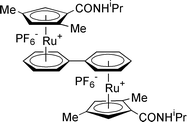
Graphical abstract: Synthesis of enantiopure planar-chiral cyclopentadienyl-ruthenium binuclear complexes bridged by aromatic systems

Supplementary files

Article information

Article type
Paper
Submitted
03 Aug 2001
Accepted
17 Dec 2001
First published
01 Mar 2002

J. Chem. Soc., Dalton Trans., 2002, 1473-1478

Synthesis of enantiopure planar-chiral cyclopentadienyl-ruthenium binuclear complexes bridged by aromatic systems

M. Yamamoto, K. Onitsuka, M. Uno and S. Takahashi, J. Chem. Soc., Dalton Trans., 2002, 1473 DOI: 10.1039/B107051G

To request permission to reproduce material from this article, please go to the Copyright Clearance Center request page.

If you are an author contributing to an RSC publication, you do not need to request permission provided correct acknowledgement is given.

If you are the author of this article, you do not need to request permission to reproduce figures and diagrams provided correct acknowledgement is given. If you want to reproduce the whole article in a third-party publication (excluding your thesis/dissertation for which permission is not required) please go to the Copyright Clearance Center request page.

Read more about how to correctly acknowledge RSC content.

Spotlight

Advertisements