


 PLATFORM UPDATE:


Novel iron(ii) complexes with hexadentate nitrogen ligands obtained via intramolecular redox reactions
Abstract
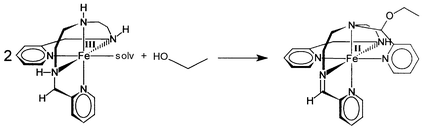
Two novel complexes: [Fe(L2′)][BPh4]2, 1, and [Fe(L3′)][BPh4]2, 2, with the hexadentate nitrogen ligands, Ln′ = 1,9-bis(2′-pyridyl)-5-[(R-2″-pyridyl)methyl]-2,5,8-triazanon-1-ene, where R = ethoxy for L2′ and methoxy for L3′, were obtained from the iron(III) complex of the pentadentate ligand, L1 = 1,9-bis(2′-pyridyl)-2,5,8-triazanonane. Complexes 1 and 2 were also obtained by making the hexadentate ligands: 1,9-bis(2′-pyridyl)-5-[(ethoxy-2′-pyridyl)methyl]-2,5,8-triazanonane (L2) and 1,9-bis(2′-pyridyl)-5-[(methoxy-2″-pyridyl)methyl]-2,5,8-triazanonane (L3) react with Fe(III), respectively. The structures of complexes 1 and 2 were characterized by COSY, HMBC, HMQC and NOESY NMR studies, and both structures were also confirmed by X-ray analysis. In both cases, the geometry around iron is a distorted octahedron. Since 1 and 2 are diamagnetic at 298 K they are low-spin iron(II) species. Both preparative methods are examples of oxidative dehydrogenation of a Fe(III) polyamine complex, in which the thermodynamically and kinetically stable final product is a low spin Fe(II) imine complex. In the case of the first method an increase in the size and denticity of the starting ligand is observed.
 Please wait while we load your content...
