


 PLATFORM UPDATE:


Molybdenum-based alkyne–isocyanide coupling reactions: synthesis of a reactive diiminometallacyclopentene complex
Abstract
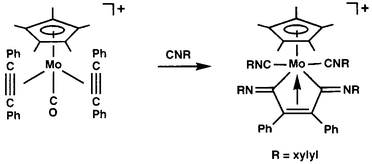
The complex [Mo(CO)(PhC![[triple bond, length as m-dash]](https://www.rsc.org/images/entities/char_e002.gif) CPh)2(η-C5Me5)][BF4] reacted with three equivalents of CPh)(CNxyl)3(η-C5Me5)][BF4] 1. With four equivalents of CNxyl,
CPh)2(η-C5Me5)][BF4] reacted with three equivalents of CPh)(CNxyl)3(η-C5Me5)][BF4] 1. With four equivalents of CNxyl, ![[upper bond 1 start]](https://www.rsc.org/images/entities/char_e010.gif) Mo{C(
Mo{C(![[double bond, length as m-dash]](https://www.rsc.org/images/entities/char_e001.gif) Nxyl)C(Ph)C(Ph)C
Nxyl)C(Ph)C(Ph)C![[upper bond 1 end]](https://www.rsc.org/images/entities/char_e011.gif) Nxyl}(CNxyl)2(η-C5Me5)][BF4] 2 which decomposes in thf at room temperature to give the tetrakis(isocyanide) complex [Mo(CNxyl)4(η-C5Me5)][BF4] 3. In CC(Ph)C(Ph)CNxyl 4, the η2-iminoacyl complex [MoCl(CNxyl)2(η2-xylNCCH2Cl)(η-C5Me5)][BF4] 5, formed by an addition reaction with Mo{C(Ph)C(Ph)CN(H)xyl}(CNxyl)3(η-C5Me5)][BF4]26. Complex 5 is more efficiently synthesized by photolysis of 3 in MoCl{C(Nxyl)C(Ph)C(Ph)CN(H)xyl}(CNxyl)2(η-C5Me5)][BF4] 9. Compound 3 is oxidised by AgBF4 to give the molybdenum(IV) complex [MoF(CNxyl)4(η-C5Me5)][BF4]210. The molecular structures of 3–6, 7/8 and 10 have been determined by
Nxyl}(CNxyl)2(η-C5Me5)][BF4] 2 which decomposes in thf at room temperature to give the tetrakis(isocyanide) complex [Mo(CNxyl)4(η-C5Me5)][BF4] 3. In CC(Ph)C(Ph)CNxyl 4, the η2-iminoacyl complex [MoCl(CNxyl)2(η2-xylNCCH2Cl)(η-C5Me5)][BF4] 5, formed by an addition reaction with Mo{C(Ph)C(Ph)CN(H)xyl}(CNxyl)3(η-C5Me5)][BF4]26. Complex 5 is more efficiently synthesized by photolysis of 3 in MoCl{C(Nxyl)C(Ph)C(Ph)CN(H)xyl}(CNxyl)2(η-C5Me5)][BF4] 9. Compound 3 is oxidised by AgBF4 to give the molybdenum(IV) complex [MoF(CNxyl)4(η-C5Me5)][BF4]210. The molecular structures of 3–6, 7/8 and 10 have been determined by
 Please wait while we load your content...
