


 PLATFORM UPDATE:


Unravelling the interfacial charge dynamics of atomically dispersed nickel on hematite {001} photoelectrodes

Abstract
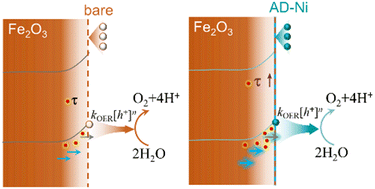
The efficiency of hematite photoanodes is fundamentally constrained by sluggish kinetics and severe surface recombination, particularly on the {001} basal plane. Here, we report a defect-remediation strategy to anchor atomically dispersed Ni (AD-Ni) sites into surface states on hematite. By integrating potential sweeping and rapid thermal locking, we create an ultrathin catalytic surface that avoids the parasitic light absorption of conventional co-catalysts. The optimized AD-Ni photoanode achieved a photocurrent density of 0.324 mA cm−2 at 1.1 V vs. RHE, representing a 69% enhancement over bare hematite, together with TOFs of 1.6 and 3.7 s−1 at 0.9 and 1.1 V vs. RHE, respectively. Intensity-modulated photocurrent spectroscopy (IMPS), combined with rate-law analysis, reveals the dual-functional role of defect-anchored Ni sites. They serve as a kinetic bridge that increases the hole transfer rate constant (ktrans) by an order of magnitude while simultaneously passivating mid-gap states to suppress the interfacial recombination rate. This work establishes atomic-level surface engineering as a robust strategy for modulating charge dynamics and overcoming kinetic bottlenecks in earth-abundant photoelectrodes.
- This article is part of the themed collection: Journal of Materials Chemistry C HOT Papers
 Please wait while we load your content...


