


 PLATFORM UPDATE:


Impact of Mg2+ and Zn2+ substitution on the structure, magnetic anisotropy and magnetostriction of NiFe2O4
 *d
and
P. N.
Anantharamaiah
*a
*d
and
P. N.
Anantharamaiah
*a
Abstract
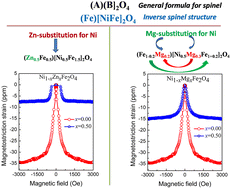
The atomistic origin of the microstructure, magnetic anisotropy and magnetostriction behaviors in Zn2+- and Mg2+-substituted NiFe2O4 samples is explored in this work. We synthesized two series of samples, Ni1−xZnxFe2O4 (NZFO) and Ni1−xMgxFe2O4 (NMFO), where x = 0.00, 0.25, 0.50, 0.75 and 1.00, by the glycine–nitrate autocombustion method. Through rigorous and self-consistent analyses, including X-ray diffraction, scanning electron microscopy, Mössbauer spectroscopy, Raman spectroscopy and magnetic measurements, we demonstrated that the microstructure of the samples is controlled by the size of the ions and the interstitial voids where the ions are substituted in spinel ferrites. Substituting ions smaller than the voids results in compressive strain in the sample, along with a decrease in the lattice parameter, while substituting larger ions leads to tensile strain and an increase in the lattice parameter relative to the parent ferrite. As observed, the particle size, agglomeration behavior and overall microstructure depend on the above-mentioned aspects. Furthermore, the crystal field effects and related magnetic anisotropy behavior depend on the strain in the material, which originates from the size difference of the substituting ions. This behavior leads to interesting changes in the magnitude and sensitivity of magnetostriction. We have observed that Zn2+ substitution into the tetrahedral interstitial voids of NiFe2O4 leads to crystallographically, mechanically and chemically stable compounds as the composition approaches pure ZnFe2O4. This is due to the fact that the Zn2+ is similar to the tetrahedral void in size, enabling a perfect fit. Conversely, Mg2+ substitution makes the NiFe2O4 sample even more unstable due to the small size of the Mg2+ ions compared with the octahedral voids. The derived magnetic anisotropy and magnetostriction behavior are aligned with the interpretation furnished. Our work explores the origin of the differences observed in the magnetostriction behaviors of Zn2+- and Mg2+-substituted NiFe2O4 samples, which is essential for comprehending the potential of the material for magnetostrictive strain sensor and actuator applications.
 Please wait while we load your content...


