


 PLATFORM UPDATE:


Dual-amino nitrobenzene functionalization enables graphene quantum dots for selective UV and high-energy blue-light filtering
 a
and
Qinghua
Zhao
*a
a
and
Qinghua
Zhao
*a
Abstract
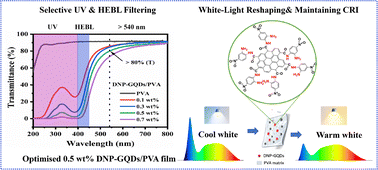
High-quality optical filters that selectively attenuate harmful ultraviolet (UV) light and high-energy blue light (HEBL, 400–450 nm), while maintaining high visible transparency, are critically important for health-conscious lighting. However, achieving such precise spectral selectivity remains challenging, as conventional blue-light filters often cause color distortion by fully eliminating blue emission. Herein, we report a molecular functionalization strategy to finely regulate the optical absorption of graphene quantum dots (GQDs) through the covalent grafting of amino-nitrobenzene derivatives. By systematically varying the substituent configuration and donor density, the interfacial donor–acceptor coupling strength between the molecular moieties and the GQD π-conjugated framework can be effectively modulated. Among the designed systems, DNP-GQDs bearing dual-amino nitrobenzene groups exhibit markedly enhanced and selective absorption in the UV and HEBL regions. Owing to their excellent water solubility, DNP-GQDs are embedded in poly(vinyl alcohol) (PVA) to fabricate transparent DNP-GQDs/PVA films. Optimized film containing 0.5 wt% DNP-GQDs achieves the near-complete shielding of UV light and HEBL, while retaining high visible-light (>540 nm) transmittance exceeding 80%. Importantly, under white light-emitting diode (WLED) illumination, the films enable controlled spectral reshaping, shifting the chromaticity coordinates from (0.3066, 0.3247) to (0.3653, 0.4070), corresponding to a transition from cool to warm white light with acceptable color rendering. This work establishes a clear molecular structure–electronic interaction–optical response relationship and provides a general strategy for designing spectrally selective nanocarbon-based optical filters for advanced lighting applications.
 Please wait while we load your content...


