


 PLATFORM UPDATE:


Elucidating thermally activated luminescence quenching in EuIII β-diketonate complexes as crystals or polymeric films for application in thermometry
 †a
Leonardo F.
Saraiva,
bc
João H.
de Araujo-Neto,
a
Javier
Ellena,
d
Hermi F.
Brito
a
and
Airton G.
Bispo-Jr
*a
†a
Leonardo F.
Saraiva,
bc
João H.
de Araujo-Neto,
a
Javier
Ellena,
d
Hermi F.
Brito
a
and
Airton G.
Bispo-Jr
*a
Abstract
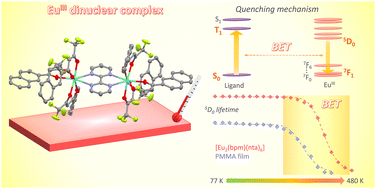
Luminescence thermometry based on EuIII β-diketonate complexes has been investigated to monitor temperature at the submicrometric scale. However, a detailed understanding of the mechanisms underlying thermally induced luminescence quenching and how these mechanisms are affected during the fabrication of practical platforms remains lacking. Here, we investigate the temperature-dependent luminescence dynamics of the dinuclear complex [Eu2(bpm)(nta)6] (nta: 1-(2-naphthoyl)-3,3,3-trifluoroacetone; bpm: 2,2′-bipyrimidine) in the crystalline state and after dispersion in poly(methyl methacrylate) (PMMA) films. Structural analysis confirms that the two EuIII centers are bridged by bpm ligands and that the coordination environment is filled by three bidentate nta− ligands. Upon incorporation into PMMA, FTIR and Judd–Ofelt analyses imply subtle conformational changes in the EuIII coordination environment. The temperature dependence of the 5D0 level lifetime shows a sigmoidal decrease with increasing temperature owing to thermally activated non-radiative processes. Intramolecular energy transfer modelling demonstrates that thermally assisted back energy transfer through the (T1 → S0)(7F1 → 5D0) pathway is the dominant quenching mechanism, while multiphonon relaxation plays a minor role. The activation energy for quenching decreases from 4985 cm−1 in the crystal to 3410 cm−1 in the PMMA:1% film, shifting the operational range to lower temperatures. Despite the reduced activation barrier, the PMMA film retains high relative thermal sensitivity (2.79% K−1 at 380 K), comparable to that of the crystalline material (3.12% K−1 at 450 K). These results shed light on the mechanisms governing thermal quenching in EuIII β-diketonate complexes and demonstrate that polymer processing enables flexible thermometric platforms without significantly compromising performance.
 Please wait while we load your content...


